
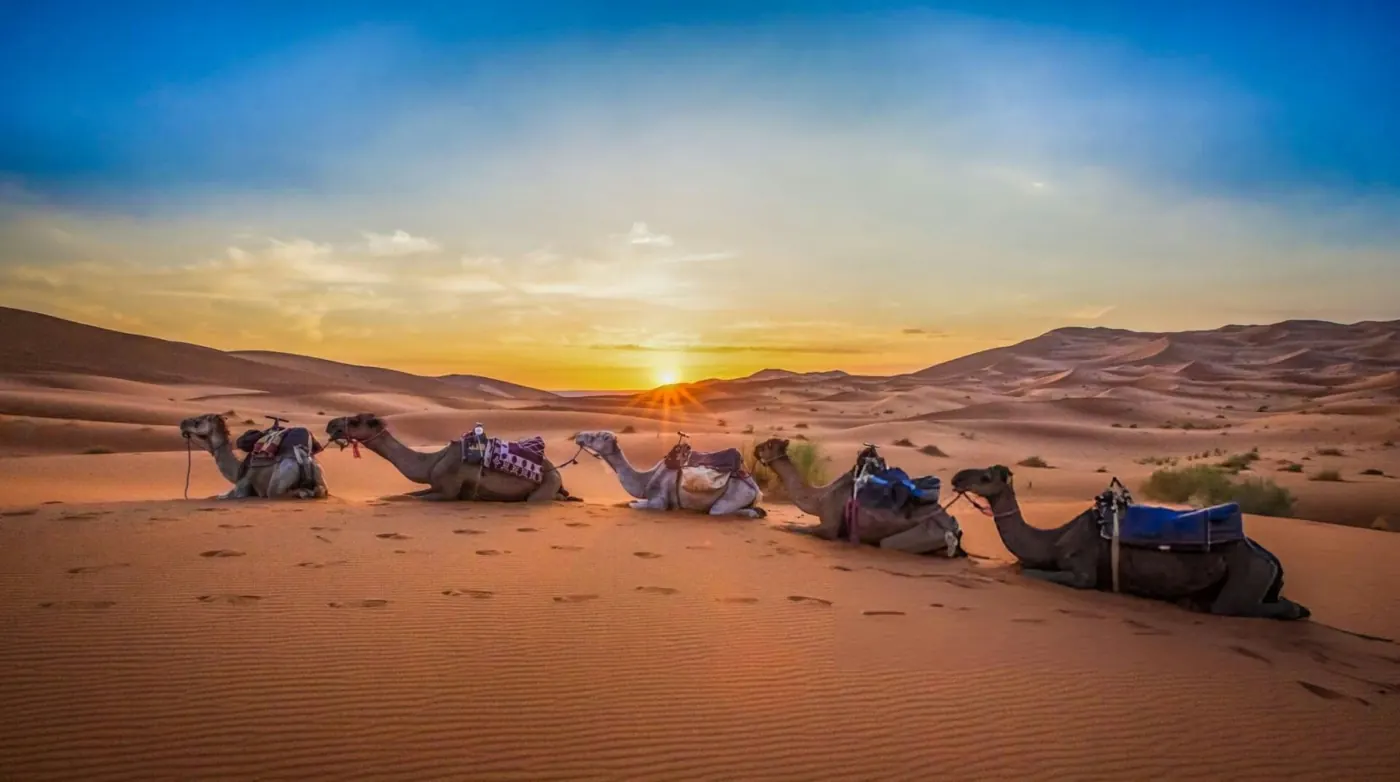
Most people arrive with one picture of Morocco in their head: the desert, or the souks, or the mountains. In practice all three sit a few days' drive apart, and the best trips let you feel the change from one landscape to the next. This is how that kind of journey usually unfolds, told by a guide team that lives in Imlil, at the foot of Toubkal.
Starting in the dunes
Life in the Sahara follows a simple rhythm. You cross the sand while the light is soft, rest through the hottest hours and reach camp in time to see the sun sink behind the ridges. Once it is dark, the sky fills with more stars than most city people have ever seen. The size of the place is hard to explain until you are standing in the middle of it.
For many travellers, a camel ride through the palm groves at the desert's edge is part of the trip. It is slow and a little bumpy, and it gives you a real sense of how people moved across this land long before there were roads.
Climbing into the High Atlas
Heading away from the desert, the ground rises into the Atlas Mountains, the range that stands between the Sahara and the greener north of the country. The walking here is a different world. Trails climb through valleys of terraced fields and old walnut trees, past Berber villages, toward the highest summits in North Africa. The tallest of them, Toubkal at 4,167 m, rises straight above our village.
The air cools as you gain height, and after the heat of the dunes that first chilly mountain morning feels like another country. A multi-day circuit around the Toubkal massif takes you over several passes and through several valleys, so you see far more than the main summit path.
Marrakech and the Ouzoud falls
Marrakech is the natural base for any Atlas trip and only a short drive from Imlil. Its old medina is loud, colourful and busy at almost any hour, and a day or two in its lanes and markets is a good contrast to quiet days in the hills.
North east of the city, the Ouzoud Waterfalls tumble in several stages into a green gorge. You hear the water long before you see it, and the paths around the falls make for easy, pleasant walking.
The people behind the places
What stays with most visitors is not only the scenery but the people they meet. Old kasbahs built from earth and straw tell the story of the families and trade routes that shaped the south. Berber (Amazigh) communities still farm their valleys much as their grandparents did, and a long shared meal with a local family, with tagine, fresh bread and glass after glass of mint tea, is often the moment travellers still talk about years later.
How the pieces fit together
- Desert: dunes, nights in camp, camel rides through the palms and very dark skies.
- Mountains: High Atlas valleys, village trails and the climb toward Toubkal.
- City: the Marrakech medina, its souks and its squares.
- Nature: the Ouzoud Waterfalls and the gorges along the way.
- Culture: kasbahs, Berber villages and home-cooked Moroccan food.
You do not need to be an experienced adventurer for any of this. A first-time visitor and a seasoned trekker can follow the same route at their own pace. If you want to sketch out your own version, our team in Imlil is happy to help you shape it around the time you have and the kind of walking you enjoy.